

How it works
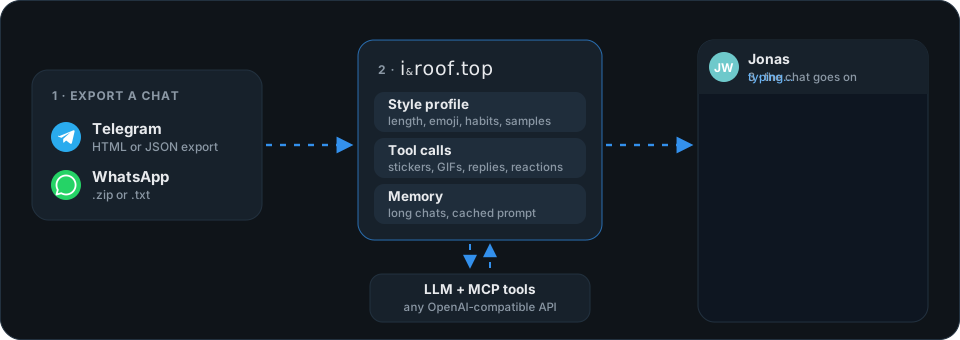
Every export becomes the same normalized messages. Then every action of the persona is replayed to the model as a tool call, so it learns how the person interacts, not just what they write, and answers the same way.
Actions as tool calls
| What the persona did | Tool call in the history and in live answers |
|---|---|
| text bubble, maybe a reply or partial quote | send_message {text, reply_to?, quote?} |
| sticker | send_sticker {sticker_id, reply_to?} |
| GIF from the library, or a URL from an MCP tool | send_gif {gif_id | url, caption?} |
| photo, video, voice, audio, file | send_media {media_id, caption?} |
| forwarded post | forward_message {message_id} |
| reaction | react {message_id, emoji} |
| (recall older history) | search_history {query} |
Several calls in one turn become several bubbles. The other side's messages become compact lines the ids refer to:
#52108 19:08 ↩ reply to #52107 (your: "grandmas lasagna 🍝"): You have made lasagna exactly zero times.
<sticker stk_156dbb381a>: a cat in a chef's hat, stirring a pot
reacted 😂 to #52107 ("grandmas lasagna 🍝")
The system prompt
| Part | |
|---|---|
| Who to be | estimate the persona's knowledge and style, and never know more than they would |
| Style profile | from the whole export: message length, capitalisation, punctuation, emoji and sticker use, reply and reaction habits, bubbles per turn, verbatim samples |
| Library | stickers, GIFs and media with how they were used |
| Notes | what you wrote about the person |
The prompt is static for a chat: no clock, no counters. The model reads the time from the — day — separators and the HH:MM stamps, and each request is a byte-identical prefix of the next one, so provider prompt caches keep hitting.
Long chats
 history budget ───────────────────────────────────────────────▶
 ┌──────────────────────┬────────────────────────────────────────┐
 │ memory (≤ 350 words) │ newest turns, cut to 60% of the budget │
 └──────────────────────┴────────────────────────────────────────┘
   relationship, facts,    the cut point stays put for a long
   topics, running jokes   stretch, so the cached prefix does too
When the replayed history outgrows the budget, the next reply first folds the oldest turns (and the previous memory) into a short summary. Nothing is spent on import or when you open a chat. The style profile still comes from the whole export, and search_history reaches every old message. Token usage (prompt, cached, completion) is shown in { }.
Media library
The chat model reads text, so a sticker is just <sticker stk_…> until it is described. Describe with AI sends the images of the missing items to the media model, which must support vision.
- GIFs, video stickers and videos go as 4 frames in order, so the model sees the motion. This needs ffmpeg (
brew install ffmpeg,apt install ffmpeg,winget install ffmpeg), otherwise the thumbnail is used. - Redo describes one item again. Any description can be edited by hand.
- Descriptions belong to the export and serve all its chats.
See it yourself with the CLI: rooftop convert <export> --persona "Jonas Weber".